When Words Run Out, Put the Kettle On: Catering a Wake With Care

A funeral reception is not a party, and nobody wants it to be. It is a pause. People arrive after the service with coats still on and conversations they are not sure how to start. The food is not there to impress. It is there to say, without a speech, that there is a seat, a cup of tea and something warm.
At Treforis, we cater wakes across the UK, and the brief is almost always the same underneath the details: please make this gentle. Please make it easy. Please do not make anyone feel they have to perform. That is the whole job.
Read the Room Before You Write the Menu
Before we talk about soup or sandwiches, we ask a few quiet questions. Who is coming? Is the reception in a church hall, a pub function room, a village hall or at home? Are people standing or sitting? Is there a formal tribute, or is this simply a gathering after the crematorium? Are there faith or cultural requirements, allergies, older guests, small children, people travelling from far away?
We also ask the family what they actually like. A wake is not the moment to introduce a bold new concept. If the person who died loved pork pies, a good pork pie should be on the table. If they hated fuss, keep the table simple. The menu can be seasonal and thoughtful without becoming a talking point. The best catering at a wake is noticed in the way it makes people feel, not in the way it announces itself.
Food That Comforts Without Fuss
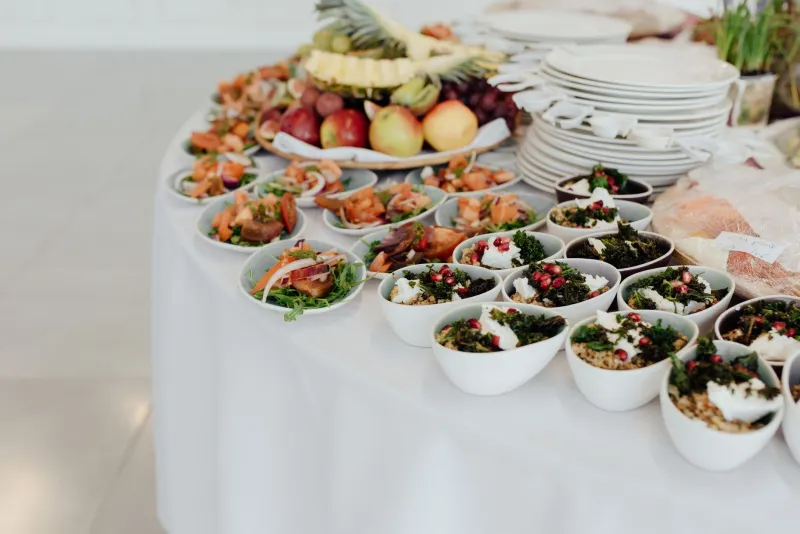
At this time of year, we lean into warm, familiar food with a seasonal edge. Soup in cups works beautifully: roast squash and sage, leek and potato, celeriac and apple. Warm granary rolls. Sliced honey-roast ham with mustard and apple chutney. Mature cheddar and pear chutney sandwiches on good bread. Celeriac remoulade with toasted walnuts. Spinach and feta filo triangles. Small sausage rolls made with proper pork and no novelty. Bara brith, Welsh cakes and a lemon drizzle cake for the tea table.
The rule is simple: nothing that needs a knife and fork if people are standing, nothing too strongly scented, nothing messy, nothing that demands attention. Warm food in small portions is comforting without being heavy. Tea and coffee should never run out, and there should be squash and water for people who do not want either.
We label everything clearly, especially vegetarian, vegan, gluten-free and dairy-free options. At a wake, nobody wants to interrogate a tray. A small, clear label is a kindness.
The Gap Between Church and Pub
The most common mistake in wake catering is a gap. The service finishes, people travel to the venue, and then they stand around waiting for food that has not arrived. It makes a difficult day harder.
If the service finishes at 2.15 and the venue is twenty minutes away, we aim to have food ready by 2.45, not 3.30. We set up before the family arrives. We keep the buffet replenished quietly. We do not clear plates the moment someone puts them down. We make sure there is a quiet corner for the people who need one, and enough chairs for the people who cannot stand for long.
Arrival drinks matter more than people expect. A pot of tea and a tray of soft drinks gives everyone something to do with their hands. If the family wants alcohol, we serve it with care and plenty of food alongside. If they do not, we do not push it.
Service With a Light Touch
Discretion is a skill. At a wake, our team is there and not there. We do not make cheerful announcements. We do not hover. We have one point of contact from the family or the venue, and we keep the kitchen noise down. We arrive early, use a side entrance if possible, and leave the room to the family.
Behind the scenes, it is still catering: prep lists, fridge space, parking, access, rubbish, dietary labels, separate serving utensils. But the aim is for none of that to reach the room. A wake should feel unhurried. The catering should feel like it has always been there.
The Quiet Details That Matter
Ask about allergies in advance, and take them seriously. Make sure there is a substantial vegan option, not just a plate of roasted vegetables. Provide gluten-free bread that is actually good. Keep small children in mind with something plain and easy. Make sure older guests have somewhere to sit. Do not let the tea run dry. Offer leftovers to the family if they want them, and deal with the rest without making it their problem.
A wake is not a catering competition. It is a table of warm, seasonal food and a team that knows when to step back. When words run out, that is often enough.