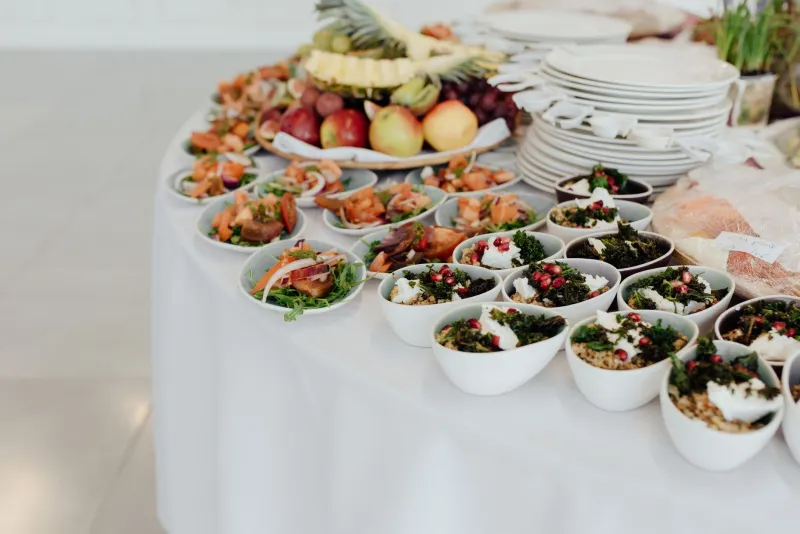
The 8:45 Handover: A Breakfast Meeting Menu That Earns Its Alarm
Photo: Jim Osley , CC BY-SA 2.0, via Wikimedia Commons
There is a particular silence in a meeting room at 8:52. The chairs are full, the slides are up, and someone is trying to balance a paper cup on a laptop. The pastry box is open, but nobody wants to be the first to take the last croissant. This is the moment a breakfast meeting reveals whether it was catered or merely ordered in. A good spread does more than fill a table. It gives a room permission to settle, talk and get on with the day.
The first ten minutes are the whole meeting
Breakfast catering is a timing job before it is a food job. Guests arrive in a narrow window — usually 8:15 to 8:45 — and they arrive hungry, damp-coated and already thinking about the first agenda item. If the coffee is not ready when the door opens, the meeting starts late, even if it starts on time. Our rule for a 9am start is simple: hot food on the table by 8:15, coffee and tea ready to pour by 8:20, and the whole spread looking settled by 8:30. There is nothing worse than a caterer still unwrapping cling film while the chair is welcoming everyone.
At larger meetings, resist the urge to run a second hot wave at 9:10. It splits the room, creates a queue at the worst moment and leaves half the guests eating while the other half are presenting. One clean handover is better. If the meeting runs past 10:30, a quiet top-up of coffee and fruit is more welcome than a second round of sausages.
Queues are a menu problem
Nobody minds a short wait at a buffet if they can see what is happening. What they mind is a single-file snake past one tray of pastries. For 50 guests, plan two service points; for 100, three, or two long tables with duplicate items at each end. Choose food that can be picked up with one hand: warm rolls, yoghurt pots, fruit, small frittatas, slices of soda bread. Anything that needs a knife and fork at 8:40 is a design flaw.
Pre-pour juices and water. Put milk and alternatives in labelled jugs. Keep tea bags and coffee on a separate table so the hot drinks queue does not block the food. And please — put the bin where people can see it. A breakfast meeting generates an extraordinary amount of napkins, cups and cling film, and hiding the bin only makes the room look like a small festival has passed through.
Dietary defaults, not afterthoughts
In 2026, a breakfast spread without a proper gluten-free and dairy-free option is not generous; it is just hopeful. The easiest way to get this right is to make the defaults work harder. Offer a vegan porridge made with oat milk, a gluten-free roll alongside the bacon, and a dairy-free yoghurt pot that is not pushed to the back of the table. Label everything clearly and give each item its own tongs or spoon. A guest with an allergy should not have to interview the room before they can eat.
Protein matters more than people expect at breakfast. Eggs, beans, yoghurt, smoked fish, cheese, even a handful of seeds on the fruit platter — these are what keep a meeting from turning into a biscuit scavenger hunt by 10:30. Sugar is a garnish, not the foundation.
Three breakfast menus, three room sizes
These are working menus, not prescriptions. Adjust for season, venue and how much walking your guests have done to get there.
20 guests — the small-room breakfast
- Warm bacon or egg buns, wrapped in paper and kept in a low oven until service
- Vegan porridge with oat milk, brown sugar and toasted seeds
- Yoghurt pots with pear compote and granola, including a dairy-free batch
- Sliced apples, clementines and grapes
- Filter coffee, tea, orange juice and water
- A small plate of pastries, cut in half, as a side rather than the main event
50 guests — the floor-wide meeting
- Bacon rolls and vegetarian sausage rolls, both in warm wraps
- Scrambled eggs kept soft in a covered dish, with gluten-free toast
- Mushroom and spinach frittata, served at room temperature
- Overnight oats, yoghurt pots and a nut-free granola
- Seasonal fruit platter — in November, pears, apples and clementines
- Coffee urns, tea, juice and a labelled dairy-free milk station
- Two service points, one at each end of the room
100 guests — the all-hands breakfast
- Pre-wrapped hot rolls in two varieties, handed out at the door
- A hot counter with scrambled eggs, beans and roasted mushrooms
- Gluten-free and vegan options on a separate, clearly labelled table
- Yoghurt, fruit and overnight oats in grab-and-go pots
- A coffee station with two urns and a dedicated milk table
- Three service points, plus a roaming tray of fruit and water
- A quiet top-up of coffee at 10:00, not a second full spread
05:00, the kitchen
Behind every calm 8:15 table is a kitchen that started when the city was still dark. On a typical breakfast run, the first job is the oven. Bacon goes on trays, rolls go in to warm, and the porridge is stirred slowly enough that it does not catch. Coffee is brewed in batches and poured into urns that have been pre-heated — a cold urn is the quiet enemy of good coffee. Fruit is cut, yoghurt pots are labelled, and the gluten-free items are kept on their own tray with their own tongs from the very beginning, not added at the last minute.
By 7:15, everything is packed into insulated boxes and the van is loaded in a sequence that matches the set-up: tables first, then hot food, then cold, then drinks. The aim is to arrive at 7:45, set up by 8:10 and be out of the room before the first guest walks in. If we are still there at 8:30, something has gone wrong. The best breakfast catering is almost invisible — the room simply finds itself ready.
A breakfast that earns its alarm
A breakfast meeting is not a morning tea break with earlier start times. It is the first hospitality of the working day, and it sets the tone for everything that follows. Get the coffee right, keep the savoury food warm, make the dietary options obvious, and give people a table that looks generous without turning into a sugar crash. Then step back. The meeting can do the rest.