Turkey on a School Night: Catering Thanksgiving When Nobody Gets the Day Off
There's a particular sort of November evening in Britain. The light has gone by half past four, the radiators are ticking, and in kitchens from Cardiff to Carlisle someone is wrestling a turkey crown onto a shelf that was never designed for it, while a small person asks — for the fourth time — whether there will be pie.
Thanksgiving has been quietly emigrating to these islands for years. It arrives in mixed households, in the luggage of colleagues on secondment, and in the general British willingness to adopt any holiday that comes with gravy. In 2026 it falls on Thursday 26 November. Nobody gets the day off. That single fact shapes everything about how you cook it.
A Holiday With No Bank Holiday
Every other feast in the British calendar comes with a cushion. Christmas has Boxing Day. Easter has a Monday. Even a wedding gives you the recovery of a Sunday. Thanksgiving gets a Thursday night, and then Friday morning, and school uniform, and a 9am call.
That is not a complaint — it is a brief. The meal has to be finishable, the kitchen has to be recoverable, and the hosts have to be functional the next morning. Which means the caterer's oldest discipline applies here more than anywhere: do the work on Wednesday.
Hosts who try to roast, mash, bake and plate between a 3.15pm school pick-up and a 7pm sit-down are asking a domestic oven to do something it cannot. The fix is unglamorous and effective. Cook the roots, the red cabbage, the stuffing and the pies a day ahead. Roast the bird on the day and let it rest under foil and a tea towel for a full forty-five minutes — longer than feels comfortable, exactly as long as it needs. Reheat in stages, in a hot oven, in the order things cool most slowly.
The Menu: Tradition, Translated
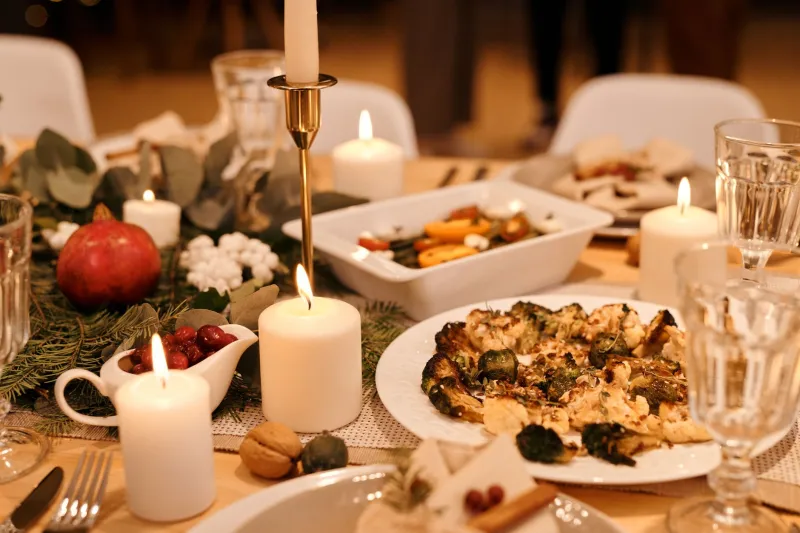
A Thanksgiving plate is a set of expectations as much as a set of flavours: something roasted and carved, something sweet and orange, something tart, something soft and pale, something with sage in it, and a pie.
You can honour every one of those without importing a single ingredient. Late November is a generous moment in the British larder — parsnips sweetened by frost, celeriac, leeks, cavolo nero, red cabbage, quince, apples that still taste of October, chestnuts, walnuts. A Norfolk bronze turkey needs no defending; a crown, for a smaller table, is the sensible choice.
The translations that work best are the ones that don't try too hard. Sausagemeat and sage stuffing is essentially a Lincolnshire forcemeat, and nobody has ever complained about that. Cranberry sauce sharpened with Bramley apple beats the tinned version and takes ten minutes. Sweet potato can be roasted in wedges rather than puréed — the marshmallow question can be raised, politely, and then set aside.
The pie is where hosts get stuck. Pecans are not a British crop, and pretending otherwise is a small dishonesty. A walnut and treacle tart, dark and sticky and built on golden syrup, does everything a pecan pie does, and does it with a larder that already exists. Quince, poached slowly in a low oven while the bird roasts, makes a better companion to the cheese course than anything shipped in a crate.
Oven Maths and the Hot-Hold Problem
For anyone cooking this at home, the real constraint is not skill but square footage. A standard 60cm oven will hold a 2.5kg crown or a small bird, one tray of roots, and nothing else. Everything else needs a home.
Caterers solve this with kit and with sequence. At home, the sequence looks like this: roots roasted at 200°C and finished early, held in a warm dish under foil; stuffing baked in a tray and cut into squares; cabbage braised on the hob and kept barely simmering; gravy made on Tuesday and reheated in a jug. The bird goes in last and rests longest.
Where a caterer is involved — and this is where the sector has quietly grown — the answer is simply a second oven, a hot cupboard, or a bain-marie brought in for the night. Food held above 63°C is safe; food loitering at 40°C for two hours is a gamble nobody needs on a Thursday night.
Serving a Room of First-Timers
Half the guests at a British Thanksgiving have never done this before. They will arrive at seven, be handed a glass of something, and quietly wonder whether they are supposed to know what is going on.
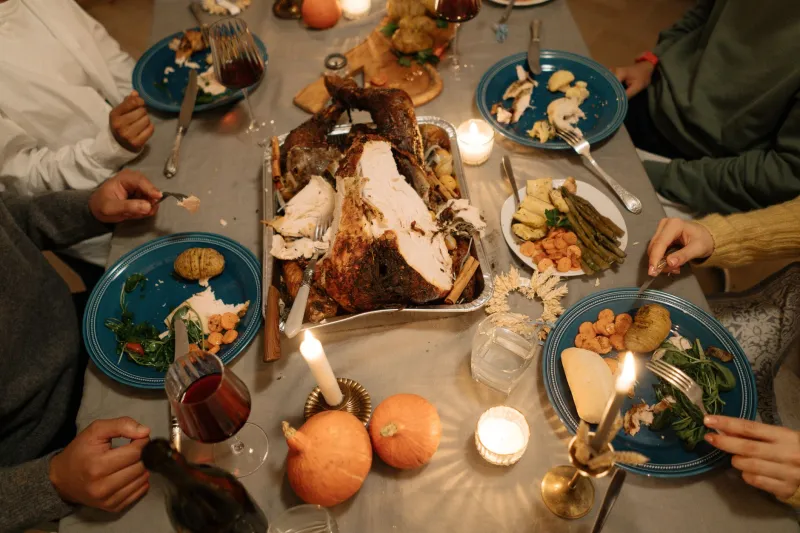
Family-style platters solve most of it. Everything on the table, everything passed, no ceremony and no courses that need explaining. Put the turkey at one end and the pies at the other and let people work it out. A short, cheerful note at the head of the table — take everything, come back twice — does more than any printed menu.
The drink is worth a thought. Something warm and appley to start; a British sparkling or a soft red with the bird; bourbon if there are Americans present and they have brought it themselves. Tea later, obviously. Always tea later.
Why Caterers Should Notice
The fourth Thursday in November is one of the quietest nights in the British catering year. Venues are free, staff are available, and there is a growing queue of people who would happily pay for the feast rather than take leave from work to cook it.
Three groups are worth watching. Mixed households who want the tradition without the labour. Expat families who want it done properly, on the right day, at a sensible hour. And offices, which have discovered that a Friendsgiving lunch on the Tuesday or Wednesday beforehand is cheaper, calmer and considerably more popular than the Christmas do in a crowded December.
It is a borrowed holiday, but it is being spent generously. Turkey on a school night, pies on a Thursday, and a kitchen that smells of sage and quince and, faintly, of somebody else's home.